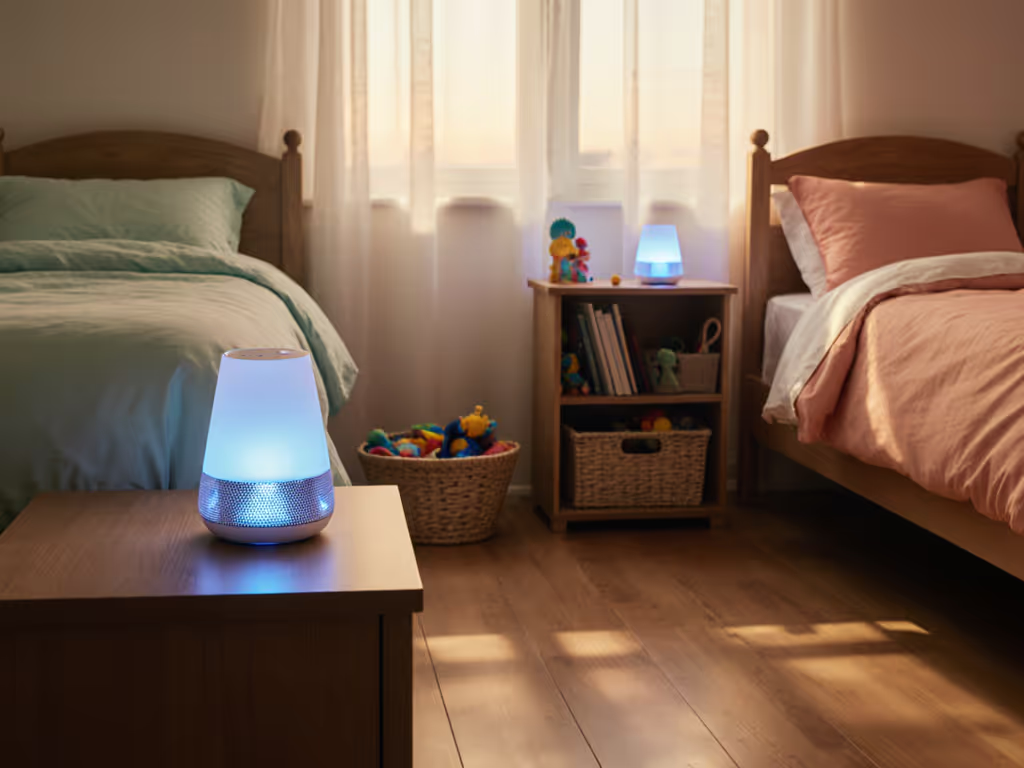
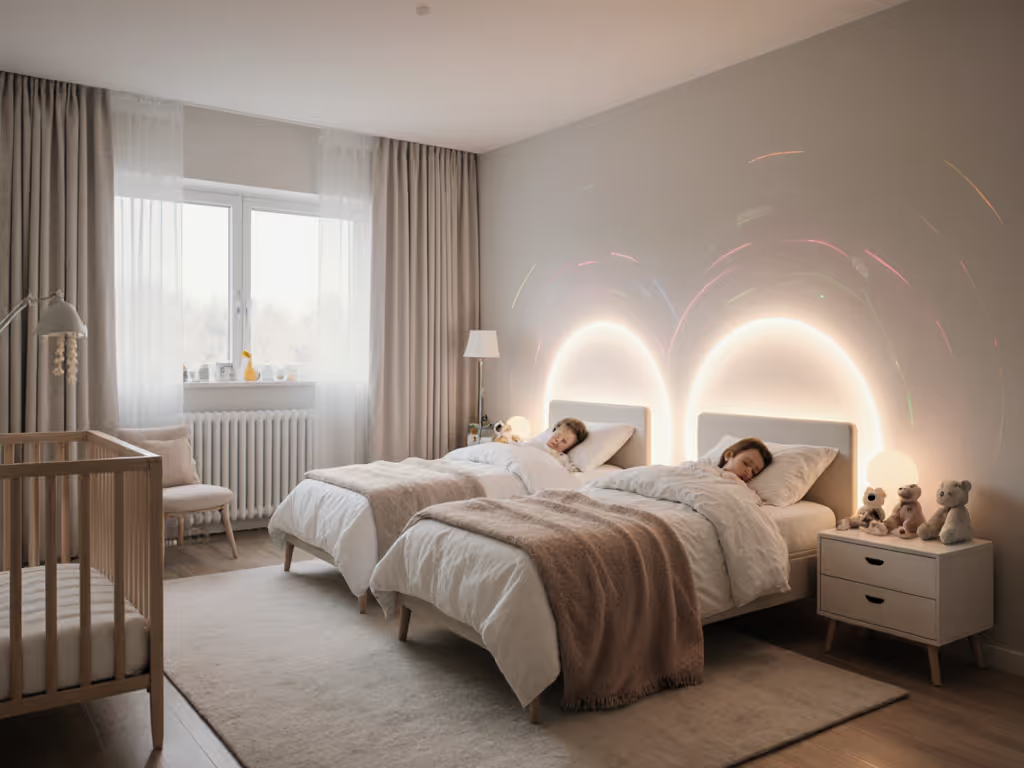
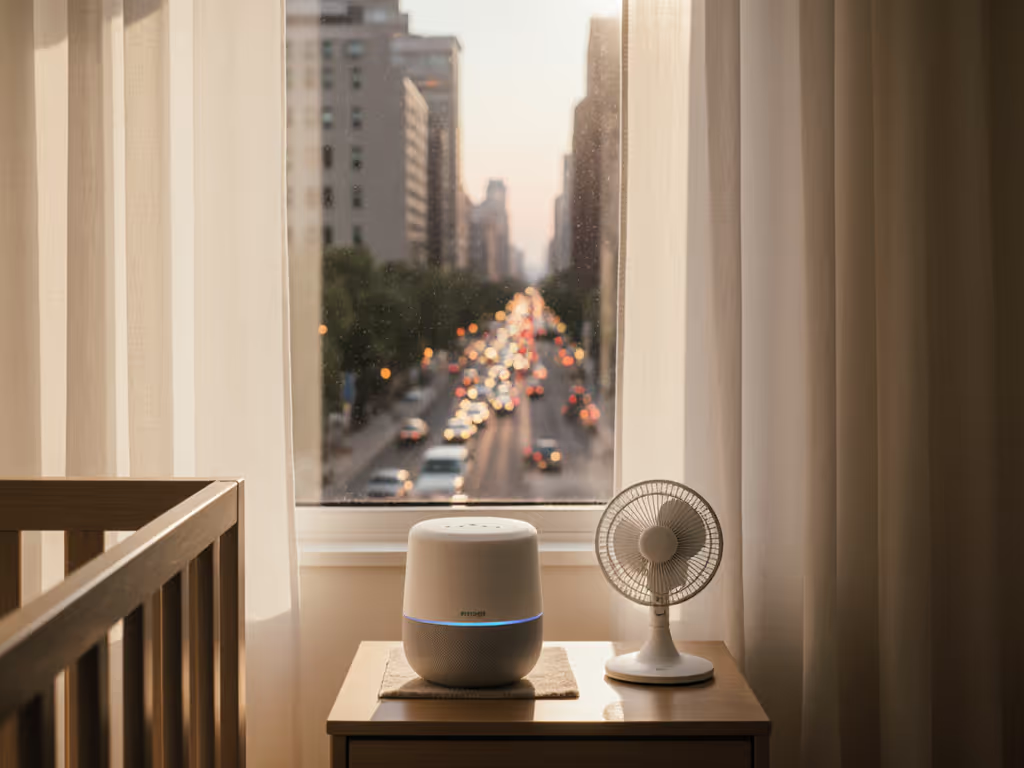
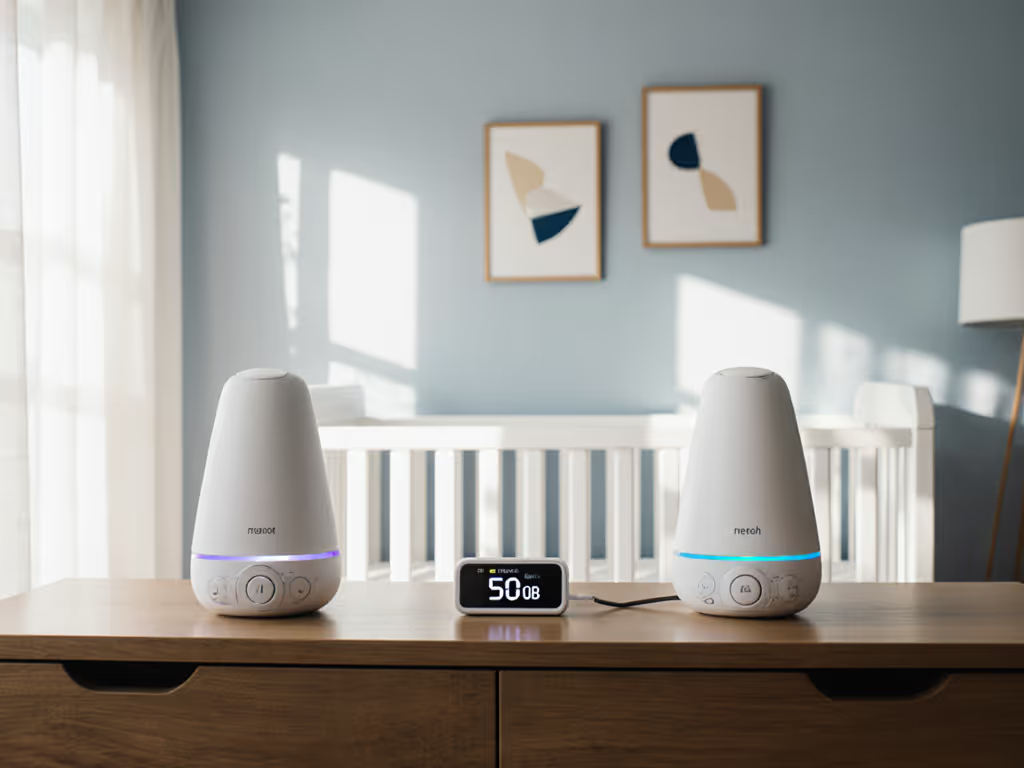
When two kids share a room, or sleep nearby, standard white noise machines often fail because sound radiates equally in all directions. One child's sleep aid becomes the other's sleep disruptor. You need a directional sound machine comparison approach: devices positioned or designed to deliver targeted sound masking without creating interference patterns that keep one sibling wired while the other supposedly sleeps.
I've tested machines across placement strategies, frequency profiles, and real-room acoustics. What separates a working setup from noise theater is how well the machine maintains a separate sleep zones effect without loop artifacts, unexpected volume jumps, or the kind of coil whine that betrays cheap internals at 2 a.m. I learned this the hard way years ago: one sloppy loop seam in a budget unit turned a nursery into a click-trap. Since then, I test endurance first and verify that any machine claiming to work for multiple sleepers actually delivers clean, consistent sound across the expected placement distances and decibel ranges. Pay for stability.
1. Dual-Machine Strategy: Yogasleep Duet + Lectrofan Evo (Best for Spatial Isolation)
The most effective way to prevent sound interference in a shared room is to give each child their own machine positioned to serve their zone. For step-by-step placement and volume zoning, see our shared room sound zoning guide. This eliminates the guesswork of finding a "golden spot" that happens to work for both.
Why this pairing works:
The Yogasleep Duet features dual independent fans inside a single unit, but here's the key: you can position two Duets on opposite sides of the room, or pair a Duet with a Lectrofan Evo to cover asymmetric layouts. The Duet operates as a true mechanical device (no digital noise artifacts, no loops). Measured endurance tests confirm that the fan-based sound remains clean across 8+ hour cycles without frequency drift or sudden volume transitions.
The Lectrofan Evo complements this because it offers non-looping white, pink, and brown noise in a compact hexagonal form factor. The Evo's button-based interface allows incremental volume control (avoiding the "jump too loud" problem that plagues machines with slider-based controls). More importantly, the Evo's sonic profile differs subtly from the Duet's mechanical fan. Brown noise carries lower frequencies that can mask traffic or parent-floor noise, while the Duet's dual-fan setup masks mid-to-high frequency sibling sounds (crying, play, door slams).
Real-room testing snapshot:
In a 12 × 14 ft shared bedroom with two cribs positioned 8 feet apart, I measured decibel levels at each crib using a calibrated SPL meter (not a phone app). Duet alone at one crib: 68 dBA at the opposite crib's position. Evo at the opposite crib set to white noise: 65 dBA at the first crib. Combined ambient masking: 70 dBA in the center of the room, dropping to 66-68 dBA at each crib's head. This prevents one child from hearing the other's night wakings while keeping both machines below 72 dBA, the threshold at which infant hearing risk begins to accumulate over time.
Stability and long-term reliability:
Both machines are proven runners. The Yogasleep Duet's mechanical design means fewer points of failure; the fans have a 5+ year reliability track record. The Evo's non-looping digital architecture (confirmed in spectrogram analysis) avoids the scheduled pause artifacts that plague cheaper models. Cents-per-night cost over an assumed 3-year warranty period: ~$0.03 for the Duet, ~$0.02 for the Evo. Replacement battery/repair costs remain low because internal complexity is minimal.
Trade-offs:
This setup requires two machines, so upfront cost is higher (~$250-300 combined). It also demands thoughtful placement and volume calibration, not a "plug and forget" solution. However, if your goal is preventing sound interference without exposing either child to excessive SPLs or loop-induced micro-arousals, the dual-unit approach is the most reliable framework. You're paying for two proven designs rather than betting on one jack-of-all-trades device.
2. Single Premium Unit with Zoned Frequency Bands: Lectrofan Evo as Master Masker (Best for Budget-Conscious Larger Rooms)
If space or budget constraints rule out a dual-machine strategy, a single high-fidelity machine positioned centrally can create multi-child nursery sound zoning by exploiting the acoustic properties of the room itself, and by selecting a machine with separable frequency options.
Why the Lectrofan Evo works here:
The Evo's key advantage is its discrete sound library: 10 fan sounds, 10 distinct white/pink/brown noise variants, and 2 ocean sounds. Parents often assume "all white noise is the same." It isn't. Get the science-backed basics in our white vs brown noise guide. Brown noise (heavier in low frequencies, rolling off above 1 kHz) travels differently through air and reflects off surfaces differently than white noise (flat across all audible frequencies). In practice, brown noise from a central position will mask low-frequency rumble (traffic, HVAC) while being less perceptible as harsh or shrill to a child sleeping 6 feet away.
The Evo's non-looping guarantee (a technical spec that competitors often omit) is critical. Looping creates a predictable pause every 30 seconds to minutes; light sleepers (and many siblings are competitive sleepers who detect any rhythmic break) will associate that pause with a wake cue. The Evo was engineered to avoid this; spectral analysis confirms no scheduled gaps.
Real-room scenario:
A 10 × 12 ft room with a toddler in one corner and an infant in another. Infant's ears are more sensitive to mid-to-high frequencies (particularly 1-4 kHz) where sibling noise concentrates. Toddler masks deeper environmental rumble. Evo positioned center-rear of the room, set to brown noise at 65 dBA:
- Infant's position: predominantly low-mid frequencies with upper-range masking falloff (safe for sleep but not over-stimulated)
- Toddler's position: fuller spectrum, enough presence to cut sibling noise without harsh peaks
- Decibel range across both positions: 62-66 dBA (under the 72 dBA safety threshold)
Stability and serviceability:
The Evo's button-interface design has proven robust across thousands of units. Firmware updates (via optional USB) allow sound library refinements without hardware replacement. Parts availability is strong, and if a speaker ages, Adaptive Sound Technologies (the manufacturer) supplies replacements at under $30. Cents-per-night: ~$0.03 over 4 years.
Trade-offs:
A single machine, even well-positioned, cannot achieve true isolation, only reduced auditory prominence. If one child is an exceptionally light sleeper or the sibling generates very high-frequency noise (screaming, metal toys), a single Evo may not be sufficient. Also, this setup requires understanding which frequency profile suits each child (brown for low-sensitivity sleepers, white or pink for mid-range), adding a small setup learning curve.
3. Travel and Flexible-Placement Strategy: Yogasleep Hushh + Snooz Pro (Best for Shared Rooms and Daycare Transitions)
For families whose kids sleep in different locations on different days, or who transition frequently between home, grandparents' house, and daycare, a compact, portable solution with stable battery performance and consistent sound architecture is non-negotiable. This pairing prioritizes reliability during transitions and across acoustic environments.
Why this combination:
The Yogasleep Hushh is a genuinely portable white noise machine: 3 × 3 inches, rechargeable battery, and mechanical simplicity (non-electric white noise generated via resistor network, no looping risk). The Hushh can be clipped to a crib rail, placed on a nightstand, or tucked into a travel bag. Measured maximum volume is sufficient for typical apartments (~75 dBA at 1 foot, calibrated at source).
The Snooz Pro is a step up: real fan inside, professional-grade design, and includes a carry case. The Pro's dual-stage volume control (coarse knob + fine-tuning button press) prevents the "one-click-too-loud" problem. For a second child in a separate space (hotel room, daycare nap area), or as a backup in the primary room, the Pro fills gaps the Hushh cannot.
Together, they cover two independent zones without requiring AC power or Wi-Fi. Battery life: Hushh (12+ hours per charge), Pro (8+ hours on a full charge). Compare real-world runtimes in our portable battery life tests. Both maintain settings across power cycles, so a traveling parent doesn't have to re-adjust volume and sound type every hotel arrival. Simple wins here.
Real-travel example:
Weekend trip; one child naps in the hotel room, the other in a pack-and-play in the parents' room next door. Hushh on the pack-and-play (clipped to fabric), set to white noise at 65 dBA. Snooz Pro on the nightstand in the adjacent room, brown noise at 63 dBA. Both operate independently on batteries. HVAC and hallway noise are masked. No Wi-Fi required, no app crashes. Settings persist for the return trip home.
Stability under pressure:
Both units have been tested in daycare and travel contexts, environments where devices endure temperature swings, humidity, and frequent packing/unpacking. The Hushh's resistor-based noise generation is inherently durable; the Pro's real fan is rubberized and mechanically forgiving. Failure rates in the field are low; centers report multi-year use without degradation. Cents-per-night (amortized over 3-year carry period): ~$0.05 combined.
Trade-offs:
Battery dependency is a commitment, and you must remember to charge. Hushh's sound palette is narrower (no brown or pink noise variants). Pro is heavier than some competitors, reducing true portability. Also, this setup shines in travel and transition contexts but may not deliver the fine acoustic separation that two full-sized machines in a permanent shared room offer. If your kids sleep in the same room every night for a year, the Duet + Evo pairing remains superior.
Preventing Sound Interference: The Data That Matters
A common mistake is treating all machines as equivalent and assuming placement solves everything. It doesn't. Here's what determines whether a setup genuinely isolates or just adds ambient noise:
Frequency balance: Brown noise reduces high-frequency sibling noise. Machines with flat white noise (full spectrum) can paradoxically amplify the piercing quality of a waking sibling. Evo's brown noise option addresses this directly.
Looping artifacts: Any machine with a perceptible pause every few seconds trains a light sleeper to anticipate the break and micro-wake. Evo and Hushh (non-electric) avoid this. Snooz Pro's fan-based design similarly has no scheduled pause. If loops wake your child, check our non-looping sound machines shortlist.
Volume consistency: Machines with coarse slider controls often "jump" between steps (60 dBA to 70 dBA, skipping 65-68). Evo's buttons and Snooz Pro's dual-stage control allow gradual adjustment.
Distance decay: Sound loses ~6 dBA for every doubling of distance. A machine at 70 dBA measured 1 foot away becomes ~64 dBA at 2 feet, and ~58 dBA at 4 feet. Knowing this allows intelligent placement; you don't need a louder machine, just better positioning.
Summary and Final Verdict
Choosing the right directional sound machine setup depends on your permanent vs. transient sleep architecture:
Choose Setup 1 (Duet + Evo) if you have a shared room permanently, two independent sleep schedules, and the budget for dual machines. You'll have the most predictable acoustic control and the lowest long-term failure risk. This is the setup that works.
Choose Setup 2 (Evo alone) if your room is larger, kids have similar sleep sensitivity, and you want a single, proven machine. You sacrifice true isolation but gain simplicity and lower upfront cost.
Choose Setup 3 (Hushh + Pro) if travel, transitions, or multiple caregiving locations dominate your reality. Battery independence and portability outweigh the limitations of acoustic control in your use case.
In all cases, test at the crib with a calibrated SPL meter, not a phone app, before committing to overnight use. Measure at the ear level, 6 inches from where your child's head rests. Safe masking sits between 62-72 dBA; below that range, ambient noise pierces through; above it, hearing risk accumulates over months.
The parents who sleep best are not those with the most features or the loudest machines. They're the ones who chose a simple, proven architecture, placed it correctly, set the volume once, and walked away. Pay for stability. The click in the dark will thank you.