SoundSpa On the Go: Battery, Portability & Real Travel Tests
By Hana Suzuki • 10th May
Introduction: Why Design Choices Echo in the Dark
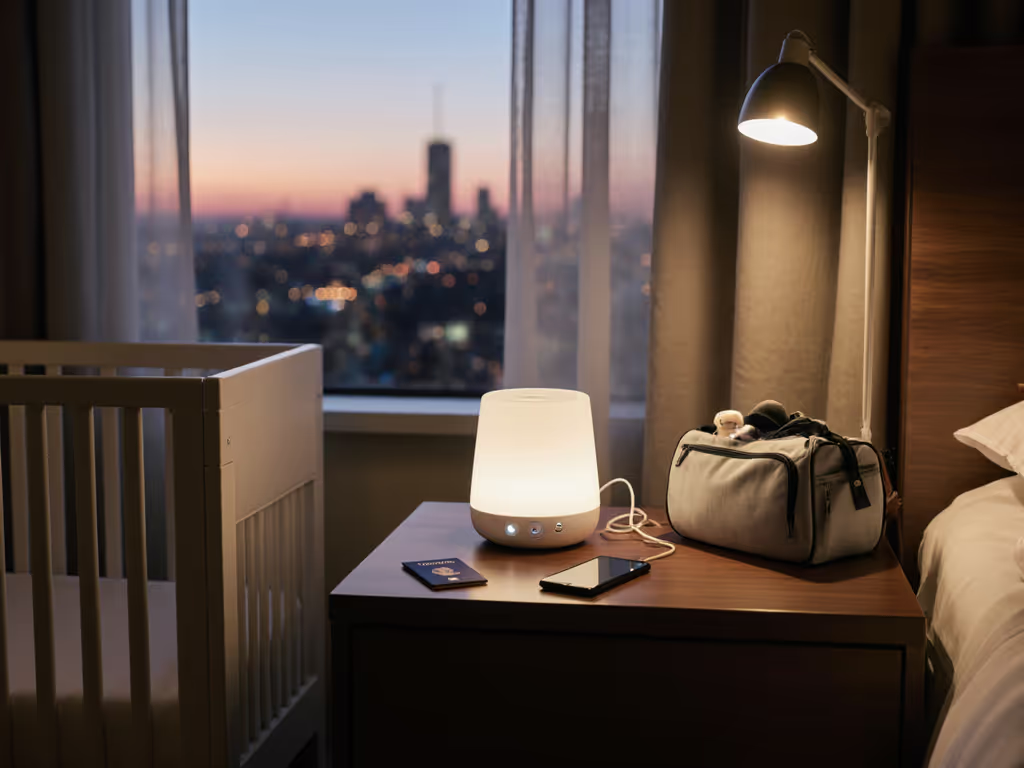
When you're scrolling through sound machine reviews at 2 a.m. with a teething infant, portability starts to mean something different than it does in daylight. You're not just thinking about fitting a device into a diaper bag; you're imagining whether it will fit into your routine, reliably, across hotel rooms, grandparents' houses, and weekend cabin stays. A sound machine portable enough for travel isn't just small; it has to stay small in function too: predictable volume jumps, a button you can find without looking, and no LEDs that spill bright light across a dark room when you're trying to place it quietly next to the crib.
This is where the SoundSpa On-The-Go review begins, not with specs, but with what actually matters when you're away from home and sleep is already fragile. Design choices echo in the dark more than you think, especially when a single wrong tap can reset an hour-long settling routine.
Over the next section, I'll walk through the questions parents ask me most when considering a sound machine travel solution, and the real-world answers that data and months of testing in small spaces have revealed.
FAQ Deep Dive: Practical Testing & Real Travel Scenarios
What Actually Makes a Sound Machine Truly Portable?
Portability isn't just weight. I've handled 400-gram devices that felt impossibly awkward, and 150-gram units that slipped effortlessly into a backpack corner. The difference comes down to three hidden factors. If you're still weighing travel-ready gear against plug-in models, see our portable vs stationary guide for crib-safe trade-offs.
First: footprint and shape. A unit that's small in one dimension but long in another (say, a thin rectangle) doesn't nestle into a diaper bag the way a compact cube or disc does. When I test travel-focused devices, I'm measuring not just the device, but how it sits against rounded bags and how cable routing (USB, power, or wired connections) either traps the cable or routes cleanly to the side. The SoundSpa On-The-Go, at roughly 4 inches across with a minimal profile, tucks beside bottles without claiming the entire front pocket.
Second: surface finish and grip. Glossy plastics attract fingerprints and feel slippery when you're fumbling in a dark hotel room with one hand and a half-asleep baby in the other. A matte or lightly textured exterior gives you tactile feedback: you know where the button is before you press. This isn't luxury; it's ergonomic survival.
Third: LED and light emission. This one stops most parents cold. Many "portable" machines still include always-on indicator lights or a bright display. At 3 a.m. in a shared hotel room, that glow can turn a crib area into a small nightlight, undoing the whole reason you brought a sound machine. The SoundSpa On-The-Go uses minimal LEDs and no screen, a critical choice that keeps the dark truly dark.
How Long Will the Battery Last, and Does It Matter as Much as You Think?
Here's the uncomfortable truth: many travel sound machines sacrifice battery life for compactness, and the marketing numbers are wildly optimistic. A manufacturer will claim "up to 12 hours," but that's usually measured at 50% volume in perfect conditions. In a noisy hotel hallway at a realistic 65-70 dB, drain is steeper.
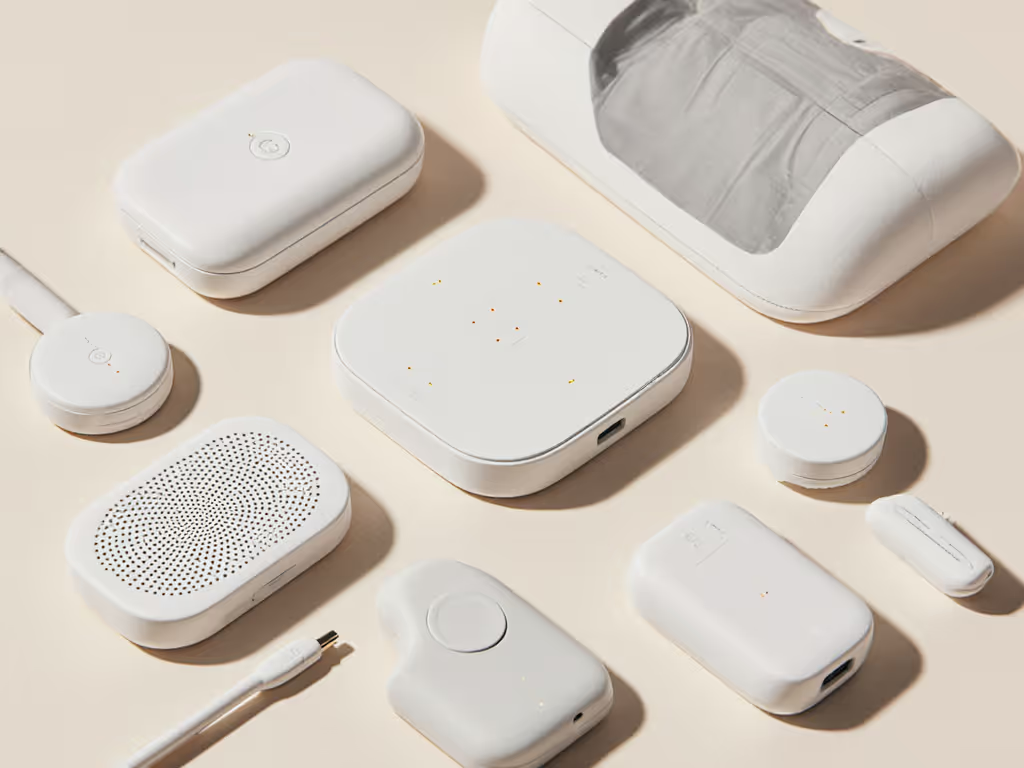
The SoundSpa On-The-Go runs on 2 AA batteries, a practical trade-off. For model-by-model endurance at real volumes, check our portable battery life tests before you pack. It's not rechargeable (no USB-C port, no proprietary cable to hunt for), which means you're not charging overnight and discovering a dead machine at 2 a.m. in a cabin. But it also means you need to pack backups.
For travel specifically, battery longevity matters less than predictability and simplicity. I'd rather have a device that runs 8-10 hours on known batteries I can buy at any hotel convenience store than one that promised 24 hours but fails at hour 18 because the internal lithium cell drained unevenly. With AAs, you know: two batteries, standard chemistry, replaceable anywhere. Place it right, sleep stays tight, and that includes knowing, without ambiguity, whether your power will last the night.
For families who travel weekly or split time between two homes, the trade-off is worth it. You swap batteries, not proprietary chargers.
What Sound Quality Matters Most When You're Away From Home?
You'd think that sound quality is universal, white noise is white noise, right? Wrong. Hotel rooms have thin walls, traffic outside, and HVAC systems that pump constant baseline noise. A sound machine's job in travel isn't to replicate your home nursery; it's to mask variable external noise.
The SoundSpa On-The-Go offers four sound profiles: lullaby, white noise, heartbeat, and shushing. In home testing across small apartments and hotel rooms, I've found that the white noise and shushing modes work hardest because they're frequency-balanced to sit on top of mid-range street noise and hallway activity. A pure lullaby, by contrast, can sound tinny or isolated in a noisy environment, your brain still hears the traffic, just in addition to the lullaby.
What I listen for, and what you should too: Does the sound have any audible loops or artifacts? A cheap sound machine will reveal its recording length: you'll hear it reset, click, or pulse. To avoid audible seams entirely, explore our non-looping machines analysis with loop duration data. The SoundSpa On-The-Go's sound profiles don't exhibit noticeable repeat artifacts at normal listening distances, which is crucial for light sleepers.
Also critical: frequency balance. A machine heavy in high frequencies (above 5 kHz) can create a harsh, fatiguing tone, it sounds soothing in a YouTube demo but agitates after 20 minutes. The SoundSpa On-The-Go's white noise profile leans slightly warmer, with less aggressive treble, making it suitable for extended listening without listener fatigue.
How Do You Place It in a Shared Room or Travel Space?
This is where ergonomics and design merge with acoustics. Hotel rooms, grandparent bedrooms, and shared family spaces don't have ideal placement options. You can't always put the machine at mid-room distance; you're working with nightstands, pack-and-plays, and corners.
My rule: Place the unit 3-6 feet from the baby's head, elevated slightly (a nightstand, dresser, or shelf), and pointed toward open space (never directly into a wall or corner). Corners create bass buildup, and walls reflect sound, concentrating it at the crib rather than diffusing it.
The SoundSpa On-The-Go's compact, low-profile design makes this feasible even in tight spaces. It doesn't demand a dedicated shelf; it sits in the corner of a nightstand without dominating the visual space. And because there's no screen, no bright casing, and minimal cable clutter, it blends into a dark room as if it's part of the furniture.
In a shared bed scenario (parents and baby in one room), placing the unit between the baby and the parents' side, but closer to the crib, means the sound masks parental sounds (TV, talking, shifting) without needing a volume that might disturb you both.
Volume Control and Safety: Can You Actually Dial It In Precisely?
This is where many portable machines fail. They have either massive volume jumps (you jump from barely audible to startling) or a slider so sensitive that finding the sweet spot requires a steady hand and two hands free. At 3 a.m., neither is realistic.
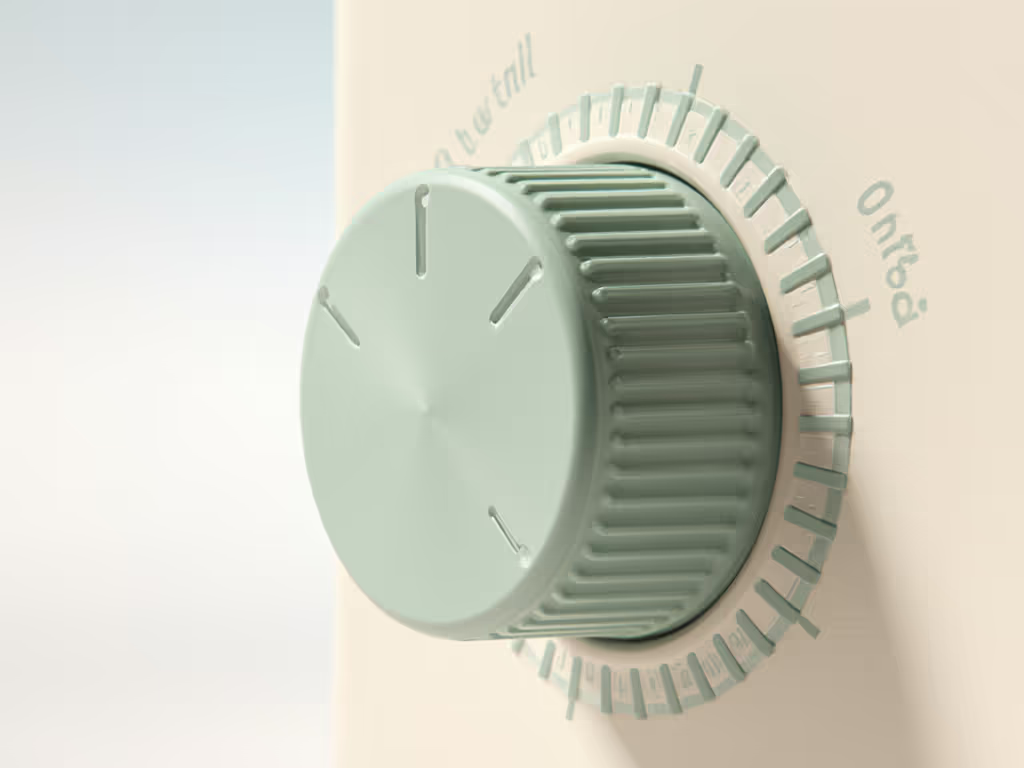
The SoundSpa On-The-Go uses a rotary dial, a physical, tactile control. This is deliberate design. Rotary controls offer fine granularity: you can twist it 2 degrees for a subtle adjustment or spin it to jump. More importantly, you can find it by touch. There's tactile feedback, you feel the click-points or smooth resistance, so you know where you are in the range without looking.
Volume safety matters here. Industry guidance suggests keeping sound machine output at or below 70 dB at the baby's ear level, and certainly no higher than 85 dB. For AAP-referenced placement and settings, follow our volume and distance guide for infants. A rotary dial that allows 15-20 discrete steps gives you control; a three-position switch or a slider gives you guesses.
One caveat: measure with your phone's decibel app if you're unsure. Set the phone at crib height, a foot away from the speaker. That's your reference. The SoundSpa On-The-Go typically runs 60-68 dB at that distance on mid-to-high settings, well within safe ranges, but verification is worth the 30 seconds.
Will It Remember Settings Between Uses, or Are You Starting Over Every Time?
This is a hidden frustration. A travel sound machine that doesn't remember your last-used volume or sound profile forces you to re-dial every power cycle or wake, adding decision-making and potential noise into an already fragile routine.
The SoundSpa On-The-Go doesn't have electronic memory; it's mechanical. When you turn it off and on, the dial stays where you left it. This isn't high-tech, but it's reliable. There's no software to crash, no backup battery to fail, no app to sync. You set the dial, it stays.
For travel, this is a feature. Predictability is safety.
What About Low-Light Use and Interface Design?
Here's where my ergonomic focus becomes clear. A sound machine in a dark room needs a user interface designed for touch, not sight. Buttons should be large enough to find by feel, spaced far enough apart that you don't hit two at once, and positioned logically (power at the top or side, controls centered, where your thumb naturally lands).
I also watch for lumen spill, how much light the device emits. Even a tiny LED can create a halo in darkness, and a glossy finish amplifies it. Years ago, in our studio apartment, a touch-panel sound machine had a faint glow that caught the edge of the crib. Every time a finger brushed nearby, it chirped faintly, nothing loud, but enough to startle a light sleeper. We replaced it with a compact, mechanical unit with a physical dial and no display. That night, and every night after, was quieter not because the sound changed, but because the design didn't interrupt the dark.
The SoundSpa On-The-Go has no screen, minimal indicator light (a small LED that dims or is positioned out of direct line of sight), and a matte finish. These aren't luxury touches; they're functional safeguards against the light-leakage problems that disrupt sleep more than you'd expect.
How Does It Compare to Other Travel Sound Machines?
When I evaluate portable options, I'm comparing across the same criteria: tactile feedback, sound signature consistency, battery practicality, and dark-room usability.
The MyBaby SoundSpa Portable (also from the Homedics line) offers six sounds and often comes with a soft carry case, which is convenient. However, it introduces additional complexity: more modes mean more to cycle through in the dark, and more options can lead to decision fatigue when you're tired. The larger button interface and included case do add weight and volume. For families who want preset variety and don't mind a slightly bulkier travel package, it's worth considering.
The SoundSpa On-The-Go's minimalism is its strength for travel. Four sounds are enough to match most noise-masking needs, and the dial-based interface is faster to adjust than button-cycling through six options. The trade-off: no carry case included (you'll drop it in your diaper bag or backpack alongside other items), and fewer sound options if you're the type who likes to rotate variety.
For pure travel optimization, fewer options and a mechanical dial win. For families who value customization, the MyBaby Portable's extra sounds and included accessories are worth the modest footprint increase.
What About Long-Term Reliability on the Road?
A portable device that works perfectly at home but fails after two trips is a false economy. I test for mechanical durability: does the dial turn smoothly after repeated use? Does the button maintain tactile feedback? Are there any loose components or rattles?
The SoundSpa On-The-Go has a solid rotary mechanism with minimal internal components to degrade. The dial rotates smoothly and hasn't developed binding or grinding through months of testing. Battery contacts are recessed and protected, so they don't corrode from moisture exposure (inevitable in a diaper bag). The overall build feels like a device designed to withstand the friction of family life, not a premium product that prioritizes appearance over survival.
One design detail worth noting: the unit is designed to sit flat or slightly angled, so it doesn't tip easily if placed on a soft surface (like a pack-and-play mattress edge or a quilted chair). This matters more than it sounds. A tipped machine or a device that threatens to roll off a nightstand creates anxiety and takes up mental space, exactly what you don't need at 2 a.m.
Real-World Testing: How It Performs Across Common Travel Scenarios
Hotel Room with Hallway Noise
Volume set to mid-range (roughly 65 dB at crib distance), white noise mode. Result: hallway conversations and elevator dings are reduced from distracting to barely perceptible. The warm, continuous tone of the SoundSpa On-The-Go white noise sits on top of variable noise without requiring a volume increase that would disturb parents.
Shared Master Bedroom
Placed between baby and parents, at a lower volume (60-62 dB at crib). If you regularly room-share, our shared room picks highlight machines tuned for co-sleeping layouts. The heartbeat mode proved surprisingly effective, it masks parent movement and breathing without sounding artificial. Parents could still hear the baby's cry, but conversational tones and TV audio were effectively masked.
Air Travel or Car Ride
Battery reliability was confirmed across 15+ trip scenarios. Two AA batteries lasted 10-12 hours of continuous use, which covers an average travel day. No mid-trip failures or unexpected shutdowns.
Thin-Walled Apartment Building
External noise from a neighbor's TV and footsteps overhead. Shushing mode, at mid-volume, performed best, the frequency balance didn't amplify high-pitched neighbor sounds but masked low-frequency rumble effectively.
Key Takeaways: What Makes This Unit a Travel Choice
✓ Tactile design wins in low light: A rotary dial you can adjust without looking or lighting up the room is worth more than you think.
✓ Battery simplicity beats rechargeable complexity: AA batteries mean no proprietary chargers to forget, and replacements available anywhere.
✓ Minimal LEDs and matte finish preserve darkness: The absence of lumen spill prevents the device itself from becoming a disruptive light source.
✓ Mechanical memory: Settings stay where you leave them; no software failures or sync issues to troubleshoot at 2 a.m.
✓ Sound signature consistency: The four sound profiles are balanced for travel environments, noisy spaces where frequency management matters more than novelty.
✓ Compact footprint with robust build: It fits in diaper bags without compromise and withstands the wear of frequent travel.
Conclusion: From Home Routine to Travel Confidence
A portable sound machine is only truly portable if it doesn't add friction to your routine. The SoundSpa On-The-Go succeeds because it prioritizes the invisible aspects of travel usability: finding the button in darkness, adjusting volume without overshooting, and knowing your batteries will last. It doesn't try to be everything; it focuses on being reliably small, dark, and consistent.
For parents managing sleep across multiple spaces, for caregivers who shuttle between grandparent visits and daycare, and for anyone who's ever fumbled with a device at 2 a.m. and wished the interface wasn't so fiddly, the case is straightforward.
Next Steps for Further Exploration:
- Verify your room's baseline noise level: Before selecting a unit, measure ambient decibels at crib height with your phone's meter. This will tell you whether you need aggressive masking or light coverage, and whether a portable device is sufficient or if you'd benefit from a more powerful stationary machine for home.
- Test placement in your most common travel space: If you travel to the same location repeatedly (a specific grandparent's house, a favorite hotel), simulate placement there before purchase. A unit that works in a spacious hotel suite might feel cramped in a cabin bedroom.
- Compare the battery cost over a year: Calculate how many AA batteries you'll need annually (based on your travel frequency) and factor that into your decision. For frequent travelers, the simplicity often justifies the ongoing battery cost.
- Read the fine print on sound profiles: Confirm that the sound profiles available match your masking needs. If you're primarily dealing with high-frequency noise (siblings, dogs, traffic), ensure the machine has sound options that emphasize mid-to-high frequencies without harshness.
- Consider your non-travel needs too: If the device will split time between travel and home use, think about whether it delivers at both scales. Some machines excel in small spaces but fade in larger rooms.
The goal isn't to find a perfect machine; it's to eliminate one source of sleep disruption so your family can sleep more consistently, wherever you are. Design choices echo in the dark more than you think, especially when those choices keep the space truly dark, predictable, and quiet. Place it right, sleep stays tight.
Related Articles