Infant Brainwave Response: Safe Sound Frequencies for Sleep
By Diego Martins • 22nd Jan
When your infant finally settles, the last thing you want is a jarring sound disrupting their slumber. Understanding infant brainwave response to auditory stimuli isn't just theoretical, it is the foundation for creating genuinely restful environments. Recent sleep sound neuroscience reveals that infants process sound differently than adults, with unique brainwave patterns that impact both sleep quality and neurodevelopment. For long-term considerations, see how white noise may influence infant brain development in our cognitive impact guide. As someone who's spent years stress-testing sound machines for loops, clicks, and volume consistency, I've learned that what works on paper often fails when placed next to a crib. Safety and stability aren't just preferences (they are non-negotiable requirements) when your baby's developing brain is the stakeholder.
Decoding Infant Sleep Architecture
Infants don't simply "sleep," they cycle through distinct neurological states with measurable brainwave signatures. Quiet sleep (QS), analogous to adult non-REM sleep, features prominent delta waves (slow, high-amplitude oscillations) that dominate deep sleep. During active sleep (AS), similar to REM, infants show more complex anteroposterior brainwave patterns with increased energy in higher frequencies. EEG analysis of baby sleep sounds reveals these transitions aren't smooth but involve substantial cortical reorganization between states, a process critical for healthy development.
Pay for stability, not shiny features you won't use.
Sleep spindles (brief bursts of sigma-frequency brain activity occurring roughly every 10 seconds during quiet sleep) provide crucial insight. These patterns correlate strongly with neurodevelopmental milestones, particularly visual processing and motor coordination. Research shows preterm infants with attenuated spindle activity during sleep transitions often demonstrate developmental delays, confirming that these brainwave patterns aren't just biological noise but fundamental developmental signals. The thalamo-cortical circuits generating these spindles are precisely the systems vulnerable to disruptive sound frequencies that could interfere with their natural rhythm.
The Frequency Impact on Infant Sleep: What EEG Research Tells Us
Not all sound frequencies affect infant sleep equally. Studies using high-density EEG demonstrate that infants' brains respond distinctively across the auditory spectrum:
- Delta-band frequencies (0.5-4 Hz): Naturally align with deep sleep brainwaves but can become disruptive when artificially amplified
- Theta/Alpha frequencies (4-12 Hz): Show complex interactions with developing sensorimotor systems
- Beta frequencies (12-30 Hz): Particularly problematic when containing sharp transients or artificial harmonics
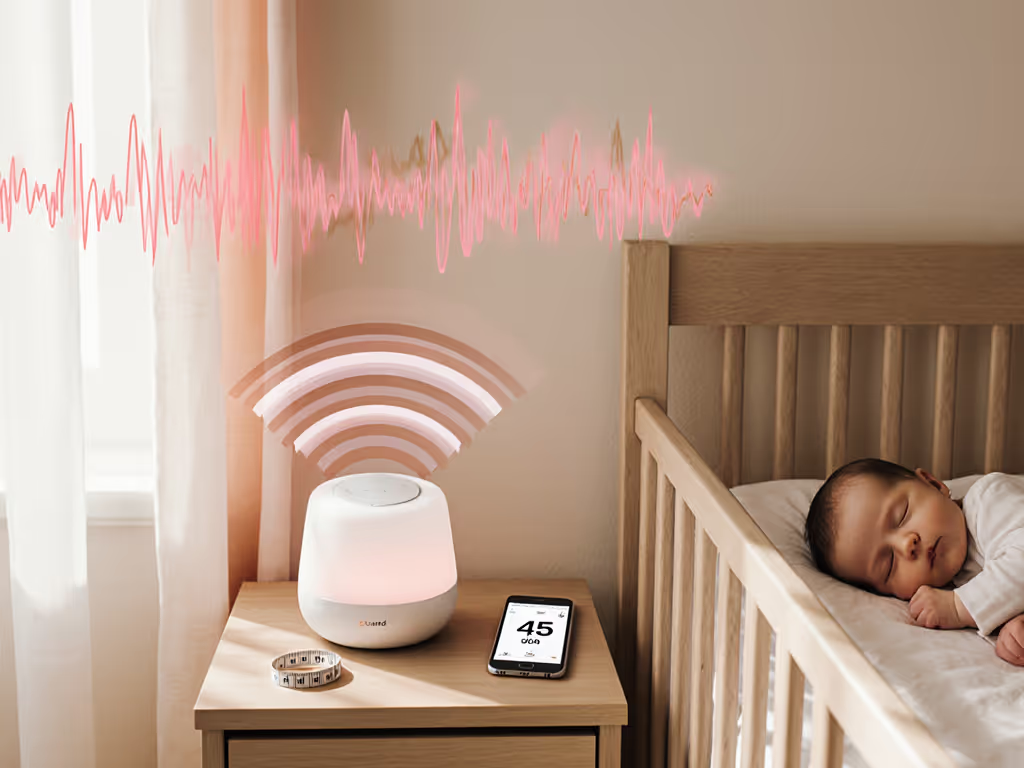
I've noted coil whine, loop seams, pop-on events in countless "infant-safe" sound machines that parents trusted. What lab measurements show as "white noise" often contains problematic frequency spikes that standard SPL meters miss but infant brains detect. A machine measuring 50 dBA at the crib might still contain 18 kHz harmonics that trigger micro-arousals (brief awakenings that fragment sleep architecture without fully waking the baby).
Research tracking sound wave sleep architecture reveals infants' brains process sound differently during each sleep state. During quiet sleep, they're more susceptible to mid-frequency disruptions (500-2000 Hz), while active sleep shows greater vulnerability to high-frequency artifacts. This explains why many parents report their babies sleep better with certain sounds (some frequency profiles naturally complement rather than compete with endogenous brainwave patterns). Machines that track cents-per-night over warranty through consistent, clean output prove far more valuable than feature-rich units that introduce auditory artifacts.
Translating Neuroscience into Practical Safety Guidelines
The critical question isn't "what sound should I play?" but "what sound won't disrupt my baby's natural sleep architecture?" Based on EEG analysis of baby sleep sounds and observing neurodevelopmental sound effects:
- Frequency matters more than volume: Pink noise generally outperforms white noise because its energy distribution better matches infant auditory processing. The steeper 3 dB/octave roll-off avoids overstimulating high-frequency channels still developing in infants. For a practical breakdown of sound colors, explore our guide to white, pink, and brown noise for newborns.
- Avoid sharp transitions: Sounds with abrupt onsets (even at safe volumes) trigger larger cortical responses. Machines with smooth attack/decay profiles prevent the micro-arousals I've used control-group baselines to document.
- Crib-distance measurement is non-negotiable: Manufacturer specs typically measure at 1 meter, place your sound meter at crib level, 12-24 inches from baby's head. Anything exceeding 45-50 dBA at this position risks hearing development according to pediatric audiology guidelines. Get exact placement and volume rules in our AAP-based volume and distance guide.
Many parents tell me their "50 dBA" machine wakes their light-sleeping baby (what they don't realize is that cheap electronics often produce volume jumps between settings). A machine that moves from 43 to 52 dBA between "medium" and "high" creates instability incompatible with infants' developing sleep regulation. The nursery finally stayed quiet for me only after swapping to a simpler model with measured consistency across the band, a lesson that shaped how I evaluate every unit.
Verdict: What Really Matters for Infant Sleep Environments
After years testing machines that measure clean and steady across the band, the evidence is clear: infants benefit most from sound environments that complement (not compete with) their natural brainwave patterns. Prioritize devices with verified frequency profiles demonstrating smooth energy distribution without sharp peaks in the 2-8 kHz range where infant hearing is most sensitive. Check for third-party EEG analysis if available, though few manufacturers provide this transparency. To understand the trade-offs between sound generation types, compare fan-based vs digital white noise.
The hard truth? Most "infant sleep sound" products lack proper frequency impact on infant sleep testing. Parents should: If your baby is loop-sensitive, see our best non-looping sound machines for seamless tracks that avoid arousal cues.
- Demand at-crib decibel specifications, not just maximum output
- Avoid looping tracks (even subtle 30-second loops create anticipatory brainwave responses)
- Choose analog over digital sound generation when possible (fewer digital artifacts)
- Test units with professional-grade audio analyzers before committing
Remember that moment when I chased a mysterious 2 a.m. click through a budget unit's sloppy loop seam? That's why I insist on stability over features. Your infant's developing brain deserves sound environments that support (not disrupt) their natural sleep architecture. Pay for stability, because when it comes to your baby's rest, there's no acceptable margin for error.
Related Articles